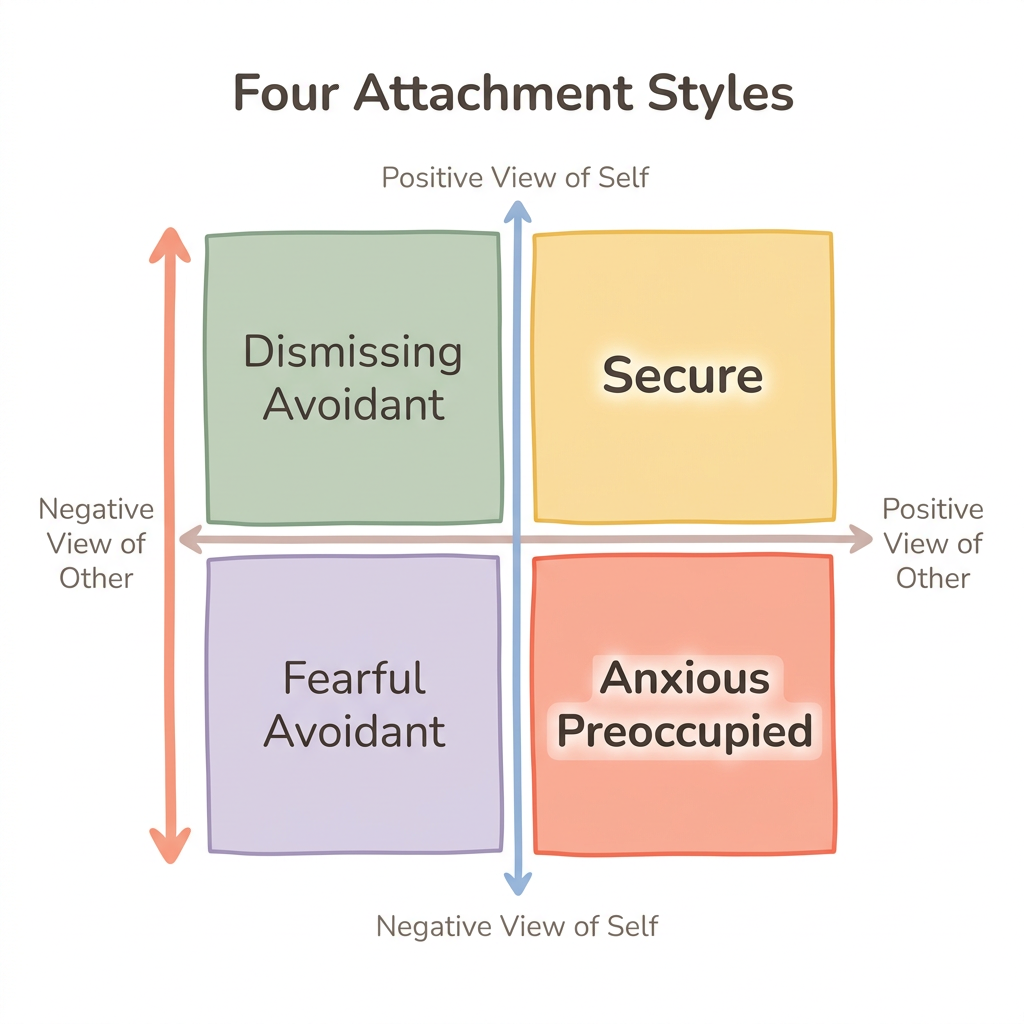
Anxious attachment is a relational pattern in which the attachment system stays hyperactivated — amplifying distress, scanning for signs of distance, and seeking reassurance that never fully lands. Bartholomew and Horowitz (1991) characterized it as a negative self-model paired with a positive other-model: other people can give love, and you are not sure you deserve to keep it. Hazan and Shaver (1987) found that approximately 19 percent of adults described themselves in these terms.
If you have ever checked your phone obsessively after sending a text, or struggled to believe someone truly loves you, your attachment system may be running the show. Anxious attachment is not neediness and it is not a character flaw. It is an adaptation your nervous system built in response to real early experience.
Key takeaway: Anxious attachment is a hyperactivated attachment strategy in which the nervous system learned to amplify distress because that is what once brought a caregiver back. It shows up as reassurance-seeking, protest behaviors, and difficulty self-soothing. Attachment patterns are moderately stable rather than fixed, and they shift gradually through repeated experiences of closeness that hold.
What Is Anxious Attachment?
Anxious attachment is an insecure attachment style defined by hyperactivation — the systematic amplification of attachment needs and emotions in order to keep an attachment figure close. Mikulincer and Shaver (2007) describe hyperactivating strategies as intensified proximity-seeking: heightened vigilance to threat, exaggerated distress signals, and difficulty disengaging from worry about a relationship.
Bowlby (1969) framed the underlying machinery as internal working models — templates formed in early life that shape what you expect from other people. In anxious attachment, the model runs roughly: connection is available, but it could be withdrawn at any moment, and staying alert is what prevents that.
Prevalence estimates vary with the measure. Mickelson, Kessler, and Shaver (1997), working with a nationally representative US sample, found 59 percent secure, 25 percent avoidant, and 11 percent anxious. The label matters less than the mechanism — if you want to know where you land, the free attachment style quiz walks through it, and 12 signs of anxious attachment covers self-assessment in detail.
Where Does Anxious Attachment Come From?
Anxious attachment develops when early caregiving is inconsistent rather than absent — sometimes warm and attuned, sometimes distracted, overwhelmed, or unavailable. Ainsworth and colleagues (1978) identified the infant version as anxious-ambivalent: children highly distressed at separation and hard to settle at reunion, alternating between reaching for the caregiver and resisting comfort.
Unpredictability is the active ingredient. A child whose bid for comfort works half the time learns something specific — not that comfort is unavailable, but that it must be won. Escalating distress becomes the strategy, because a bigger signal is harder to miss.
Your nervous system learned this for good reason: it kept connection possible where connection was not guaranteed. What worked at four becomes expensive at thirty-four, when the same amplification that once summoned a caregiver reads to a partner as pressure.
Origin Story Reflection (for anxious attachment)
- Write down 3 early memories of needing comfort from a caregiver
- For each, ask: did comfort arrive consistently, or only sometimes?
- Notice how the unpredictability felt in your body — tension, urgency, a pit in your stomach
- Write one sentence connecting that early experience to a pattern you notice today
This traces present-day patterns back to the internal working model that generated them. Reflective awareness of your own history is central to earned security — you cannot revise a story you have not yet read.
What Are the Signs of Anxious Attachment in Relationships?
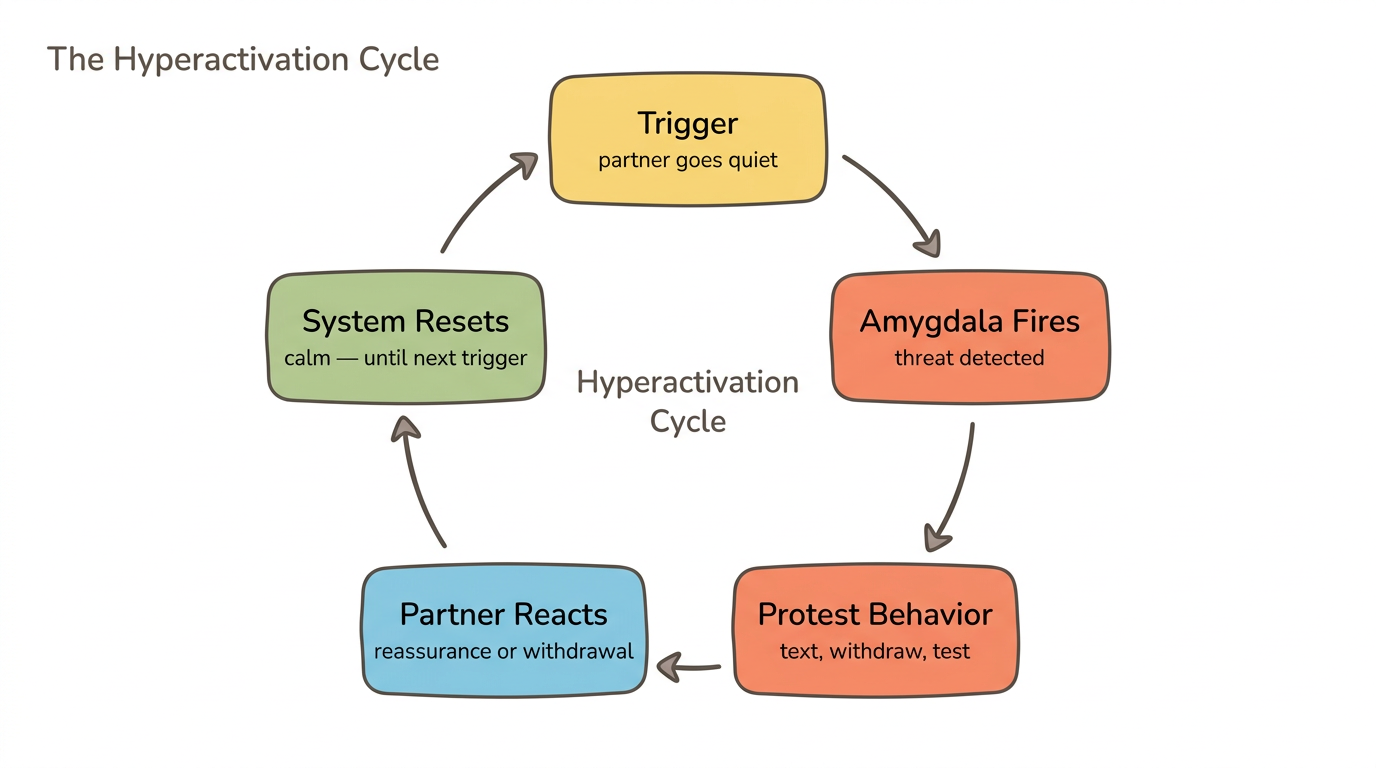
Anxious attachment shows up as protest behaviors — indirect attempts to reestablish connection when the attachment system registers a threat. Levine and Heller (2010) named these as the observable surface of hyperactivation: not manipulation, but a nervous system in alarm trying to close a gap it perceives as dangerous.
In early dating, the pattern often looks like intensity — falling fast, feeling consumed, reading deeply into every text and pause. Committed relationships shift the flavor toward monitoring, where reassurance-seeking increases and a mental scoreboard starts tracking who reaches out more.
The most common protest behaviors:
- Excessive calling or texting when a partner does not respond, driven by escalating activation rather than anything new to say
- When your partner goes quiet, going quiet yourself — not because you want distance, but to test whether they will pursue
- Keeping score of who said "I love you" last, who initiated plans, who texted first
- Snapping or picking a fight. The feeling underneath is fear of disconnection; what comes out looks like hostility
- Threatening to leave to force reassurance, even when leaving is the last thing you want
- Compulsively checking a partner's likes, follows, and online activity
- Outsourcing interpretation — asking friends to decode your partner's behavior
People-pleasing is often an anxious attachment strategy — prioritizing a partner's needs to secure connection instead of naming your own. If texting silence sends you spiraling, that makes more sense as attachment activation than as overreaction.
Li and Chan (2012) analyzed 73 studies with 21,602 participants and found that both attachment anxiety and avoidance negatively predict relationship quality. Candel and Turliuc (2019) found that your own insecurity and your partner's each independently lower satisfaction. Paired with someone avoidant, pursuit triggers withdrawal and withdrawal intensifies pursuit.
Protest Behavior Inventory (for anxious attachment)
- For one week, notice each urgent pull to act — text again, check their location, ask "are we okay?" for the third time
- Log four things: the trigger, the urge, the need underneath it, and what you actually did
- At week's end, look for repeats — which triggers recur, which needs keep going unmet
- Pick one recurring need and name one direct, non-protest way to ask for it
This exposes the gap between an activated attachment system and the actual relational need. Naming the need underneath the urge is the first move in interrupting the hyperactivation cycle.
What Triggers Anxious Attachment?
Ambiguity triggers anxious attachment more reliably than conflict does. An open fight gives your system information. A three-word reply or an unexplained gap gives it nothing — and an unfilled gap gets filled with the worst available story.
Downey and Feldman (1996) described this as rejection sensitivity: a disposition to anxiously expect rejection, readily perceive it, and react intensely to it. Once that expectancy is active, ambiguous behavior gets read as intentional rejection.
Common triggers include:
- Delayed or short responses — a reply that takes hours, or lands as "ok" when you wrote three paragraphs
- A partner asking for space, or wanting an evening alone
- Changes in tone or routine — less warmth than usual, a cancelled plan, a shift you can feel but cannot name
- Perceived competition for attention: friends, family, work, a phone at dinner
- Milestones, including good ones. Getting closer raises the stakes of losing it, which is why things can feel worse when the relationship is going well
The trigger is rarely the event itself. It is the meaning your internal working model assigns in the first two seconds, and that meaning was written long before this partner existed.
What Happens in Your Brain When Anxious Attachment Activates?
Anxious attachment is a measurable neurobiological event, not just a feeling. When the attachment system activates, threat-detection circuitry outpaces regulatory circuitry, and your body commits to an emergency before your reasoning has a vote.
Amygdala Hyperreactivity
Vrtička and colleagues (2008) found attachment anxiety associated with increased amygdala activation during social appraisal. The threat-detection center fires harder and faster, and anxiously attached people tend to catch shifts in facial expression earlier than others. Imaging during rejection cues shows heightened amygdala response alongside reduced prefrontal engagement, which is why your rational mind can feel offline mid-argument.
The Cortisol Cascade
Your stress axis behaves differently under attachment anxiety. Research finds enhanced cortisol reactivity to psychosocial stress among people higher in attachment anxiety, with elevated output persisting for days afterward — consistent with attachment anxiety functioning as a chronic social stressor rather than an acute one. The style was forged when disruption could arrive without warning, so the body learned to stay ready.
The Regulatory Cost
Zhang and colleagues (2022) meta-analyzed 224 studies across 245 samples and 79,722 participants, finding attachment anxiety moderately associated with negative mental health outcomes (r = .42) — depression, anxiety, loneliness — and inversely associated with life satisfaction and self-esteem (r = −.29). For the fuller picture, see how attachment style affects your nervous system.
Living in a body wired for chronic threat detection is genuinely tiring. These circuits were built by repetition, which is also how they get rebuilt.
Vagal Brake Reset (somatic technique for anxious activation)
- Notice the moment of activation — racing heart, chest tightness, the urge to check your phone
- Place one hand on your chest, one on your belly
- Exhale slowly for 6 to 8 counts through pursed lips — the long exhale is what engages the vagus nerve
- Inhale into your belly for 4 counts
- Repeat for 5 cycles, then ask: has the urgency shifted even slightly?
This engages the ventral vagal system that chronic hyperactivation suppresses. Porges (2011) identifies the vagus nerve as the pathway between social engagement and felt safety. You are not thinking your way to calm. You are breathing your way there.
Am I in Love, or Anxiously Attached?
Both can be true at once, which is what makes the question hard. The useful discriminator is not intensity but direction: love tends to expand your life, while attachment anxiety narrows it around one person's availability.
| Secure love | Anxious activation | |
|---|---|---|
| Baseline feeling | Settled, warm, steady | Urgent, braced, unresolved |
| What calm does | Deepens the connection | Raises suspicion something is wrong |
| Attention | Wide — friends, work, your own life continue | Narrow — mostly on their responsiveness |
| Reassurance | Received and retained | Relieves briefly, then wears off |
| Absence | Missing them, tolerably | Alarm, rumination, a need to resolve it now |
The clearest signal is what happens in the quiet. Secure attachment rests in calm; anxious attachment often gets louder in it, because an unthreatened system finally has room to anticipate the next threat.
Worth naming: chronic anxiety about a specific relationship is sometimes accurate information about that relationship. Relationship anxiety versus not being in love takes on that distinction directly.
How Is Anxious Attachment Different From an Anxiety Disorder?
Anxious attachment is a relational pattern triggered by attachment-specific threats, while generalized anxiety disorder and panic disorder are clinical conditions with broader triggers and formal diagnostic criteria. They co-occur often, and they are not the same thing.
| Dimension | Anxious Attachment | Anxiety Disorder (GAD/Panic) |
|---|---|---|
| Trigger | Perceived rejection, abandonment, partner distance | Health, work, finances, safety, social evaluation |
| Context | Primarily close relationships | Multiple life domains |
| Onset | Activates when the attachment system is threatened | Situational or chronic, no relational trigger needed |
| Treatment | EFT, attachment-focused therapy, relational repair | CBT, medication, exposure therapy |
| Diagnostic status | Not a clinical diagnosis | DSM-5 diagnosis with specific criteria |
The overlap is well documented — Mickelson, Kessler, and Shaver (1997) found generalized anxiety disorder positively associated with anxious attachment and negatively associated with security.
A practical way to tell them apart: if anxiety spikes when a partner goes quiet but work and solo hours feel comparatively steady, that is attachment activation rather than generalized anxiety. If it pervades most areas of life regardless of relational context, a clinical evaluation is worth pursuing.
If you recognize both anxious and avoidant patterns in yourself, pushing people away while wanting them close may point toward disorganized attachment, which alternates between hyperactivation and shutdown.
What Are the Hidden Strengths of Anxious Attachment?
Hypervigilance is costly, and it also built something real: a sensitive emotional radar. Your attachment system made you an unusually accurate reader of other people — you register a shift in tone before anyone else in the room, and you notice the friend who has gone quiet.
Li and Chan (2012) found that anxiously attached individuals can still deeply appreciate their relationships when they feel valued. Unlike avoidance, which suppresses emotional experience, anxious attachment keeps the channel wide open.
Reframing is not pretending the pain away. It is recognizing that attunement is an asset once it is regulated — the goal is not to dull your sensitivity but to pair it with enough self-regulation that you can use it on purpose.
What Therapy Works Best for Anxious Attachment?
Emotionally Focused Therapy (EFT) has the strongest evidence base for attachment-related relationship distress. Johnson and colleagues (1999) reported an effect size of d = 1.31, larger than any other couple intervention measured at the time, and Beasley and Ager (2019) reviewed 9 randomized controlled trials across 19 years and found Hedges's g = 2.09.
EFT works by surfacing the vulnerable emotion underneath a protest behavior, turning "why didn't you text me back" into "I got scared that I don't matter to you." Your distress gets received rather than managed.
Individual attachment-focused work and CBT also help, and here one of anxious attachment's strengths shows up: anxiously attached clients tend to seek help readily, disclose distress openly, and stay engaged. The same drive that fuels reassurance-seeking gets you through a therapist's door.
Polyvagal-informed approaches add a body-first layer. Dana (2018) teaches clients to notice the shift out of ventral vagal safety into sympathetic mobilization, and to treat that as a cue for co-regulation rather than protest. For a broader roadmap, see how to develop secure attachment as an adult.
Can Anxious Attachment Be Healed?
Anxious attachment does not usually vanish. It loses its grip — activation still arrives, and it stops making your decisions. Fraley (2019) describes adult attachment styles as moderately stable rather than fixed, with test-retest correlations near r = .40, which is the profile of something durable that still moves.
You rewire it by noticing 10 percent earlier, responding 10 percent differently, 10 percent more often. Progress is gradual and nonlinear — old patterns will show up at full volume on hard days, and that is not failure.
Three pathways carry the shift:
1. The therapeutic relationship. A consistent, attuned therapist supplies the reliable responsiveness that was missing, and over time that relationship gets internalized as a competing template.
Attachment styles do shift inside secure relationships, which makes a steady partner the second pathway. When bids for connection are met without defensiveness or withdrawal, your threat assessment slowly recalibrates.
3. Self-directed practice. Security priming has experimental support: Gillath, Karantzas, Romano, and Karantzas (2022) meta-analyzed 120 studies with 18,949 participants and found an overall effect of d = .51, strongest for affective outcomes and largest in repeated-priming designs. Somatic regulation and learning to express needs directly rather than through protest build the same resources.
What clinicians call earned secure attachment does not mean never feeling anxious again. It means catching activation sooner, settling faster, and choosing your response instead of being carried by it.
The Pause Protocol (adapted from Levine and Heller, for anxious attachment)
- When the urge to protest arrives, name it: "my attachment system just activated"
- Set a timer for 10 minutes
- During the pause, do 5 cycles of extended-exhale breathing (4 counts in, 6 to 8 counts out)
- When the timer goes off, ask: "What do I actually need right now?"
- Choose one direct, non-protest way to meet it — a vulnerable text, a call to a friend, or simply letting the need be named
This inserts a gap between activation and action — the core mechanism of moving from reactive to reflective responding. The 10 minutes let the initial stress response subside while the breathing engages your vagal brake. The gap widens with practice.
For ten techniques built specifically for anxious activation, see how to self-soothe anxious attachment.
When Should You Seek Professional Help?
Self-help has real limits, and noticing that you have reached one is not a failure — for anxiously attached people, reaching out is a strength already in your repertoire. Seek professional support when:
- Attachment anxiety co-occurs with depression — the association is well established (Zhang and colleagues, 2022), and together they reinforce each other in ways self-regulation alone rarely interrupts
- If you are experiencing thoughts of suicide, connect with a professional immediately. That is not something to work through alone
- Protest behaviors are escalating despite your awareness of them
- You understand the cycle intellectually and still cannot interrupt it in the moment. That gap usually means your nervous system needs co-regulation, not more information
- Substance use or relationship violence is involved — these require specialized clinical care beyond attachment work
A therapist trained in EFT, attachment-focused therapy, or polyvagal-informed approaches can offer the consistent, attuned relationship that teaches your nervous system a new template from the inside out.
Frequently Asked Questions
What does anxious attachment feel like?
Anxious attachment feels like urgency in the body — a dropped stomach when a text goes unanswered, a mind replaying a partner's tone for evidence. Closeness feels good but never quite settles, because the nervous system stays braced for the moment it disappears.
What causes anxious attachment?
Anxious attachment typically develops from inconsistent caregiving — a caregiver who was sometimes warm and responsive, sometimes emotionally unavailable. That unpredictability teaches a child that love is real but unreliable, so amplifying distress becomes the strategy that reliably keeps a caregiver close (Ainsworth and colleagues, 1978).
What triggers an anxiously attached person?
Ambiguity triggers anxious attachment more reliably than conflict. Delayed replies, a flat tone, cancelled plans, a partner needing space. Downey and Feldman (1996) describe this as rejection sensitivity — anxiously expecting rejection and reading ambiguous behavior as intentional.
How do you soothe anxious attachment?
Start with the body rather than the thoughts. Extended-exhale breathing with a 6 to 8 count exhale engages the vagus nerve and lowers activation. Then name what is happening and pause before acting. Security priming also reduces hyperactivation.
Am I in love or just anxiously attached?
Love tends to feel steady and expands your life. Anxious activation feels urgent and narrows it around one person's availability. A useful test is what happens in calm: secure love rests in it, while attachment anxiety often gets louder in it.
Is anxious attachment the same as having an anxiety disorder?
Anxious attachment is a relational pattern triggered by attachment threats such as perceived rejection or distance. Anxiety disorders involve broader symptoms across life domains and carry formal diagnostic criteria. They frequently co-occur (Mickelson and colleagues, 1997) but call for different treatment.
Does anxious attachment ever go away?
Attachment patterns shift. Fraley (2019) describes attachment styles as moderately stable rather than fixed, with test-retest correlations near r = .40. Anxious attachment tends to lose its grip rather than disappear — activation still comes, but it stops running the decision.
What therapy is best for anxious attachment?
Emotionally Focused Therapy has the strongest couple evidence, with effect sizes from d = 1.31 (Johnson and colleagues, 1999) to Hedges's g = 2.09 (Beasley and Ager, 2019). Individual attachment-focused therapy and CBT also help, and anxiously attached people engage readily in treatment.
Want to Go Deeper?
Start with the free attachment style quiz — 12 research-backed questions with full results instantly, no email required. Then Meadow’s 66-day program of daily practices helps you build earned security.
Take the free attachment style quiz →Already know your style? Download Meadow for iPhone
References
Foundational Works
-
Ainsworth, M. D. S., Blehar, M. C., Waters, E., & Wall, S. (1978). Patterns of Attachment: A Psychological Study of the Strange Situation. Lawrence Erlbaum.
-
Bowlby, J. (1969). Attachment and Loss, Vol. 1: Attachment. Basic Books.
-
Hazan, C., & Shaver, P. (1987). Romantic love conceptualized as an attachment process. Journal of Personality and Social Psychology, 52(3), 511–524.
-
Bartholomew, K., & Horowitz, L. M. (1991). Attachment styles among young adults: A test of a four-category model. Journal of Personality and Social Psychology, 61(2), 226–244.
-
Mikulincer, M., & Shaver, P. R. (2007). Attachment in Adulthood: Structure, Dynamics, and Change. Guilford Press.
Research Studies
-
Mickelson, K. D., Kessler, R. C., & Shaver, P. R. (1997). Adult attachment in a nationally representative sample. Journal of Personality and Social Psychology, 73(5), 1092–1106.
-
Downey, G., & Feldman, S. I. (1996). Implications of rejection sensitivity for intimate relationships. Journal of Personality and Social Psychology, 70(6), 1327–1343.
-
Li, T., & Chan, D. K. S. (2012). How anxious and avoidant attachment affect romantic relationship quality differently: A meta-analytic review. European Journal of Social Psychology, 42(4), 406–419.
-
Candel, O. S., & Turliuc, M. N. (2019). Insecure attachment and relationship satisfaction: A meta-analysis of actor and partner associations. Personality and Individual Differences, 147, 190–199.
-
Zhang, X., Li, J. H., Xie, F., Chen, X., Xu, W. J., & Hudson, N. W. (2022). The relationship between adult attachment and mental health: A meta-analysis. Journal of Personality and Social Psychology, 123(5), 1089–1137.
-
Fraley, R. C. (2019). Attachment in adulthood: Recent developments, emerging debates, and future directions. Annual Review of Psychology, 70, 401–422.
-
Vrtička, P., Andersson, F., Grandjean, D., Sander, D., & Vuilleumier, P. (2008). Individual attachment style modulates human amygdala and striatum activation during social appraisal. PLOS ONE, 3(8), e2868.
-
Gillath, O., Karantzas, G. C., Romano, D., & Karantzas, K. M. (2022). Attachment security priming: A meta-analysis. Personality and Social Psychology Review, 26(3), 183–241.
Clinical and Applied Sources
-
Johnson, S. M., Hunsley, J., Greenberg, L., & Schindler, D. (1999). Emotionally focused couples therapy: Status and challenges. Clinical Psychology: Science and Practice, 6(1), 67–79. (Effect size d = 1.31)
-
Beasley, C. C., & Ager, R. (2019). Emotionally Focused Couples Therapy: A systematic review of its effectiveness over the past 19 years. Journal of Evidence-Based Social Work, 16(2), 144–159. (Hedges's g = 2.09)
-
Levine, A., & Heller, R. (2010). Attached: The New Science of Adult Attachment and How It Can Help You Find and Keep Love. TarcherPerigee.
-
Porges, S. W. (2011). The Polyvagal Theory: Neurophysiological Foundations of Emotions, Attachment, Communication, and Self-Regulation. W. W. Norton.
-
Dana, D. (2018). The Polyvagal Theory in Therapy: Engaging the Rhythm of Regulation. W. W. Norton.
This article is for educational purposes only and is not a substitute for professional mental health treatment. If you are experiencing significant distress, suicidal thoughts, or relationship crises, please reach out to a licensed mental health professional or contact the 988 Suicide and Crisis Lifeline by calling or texting 988.